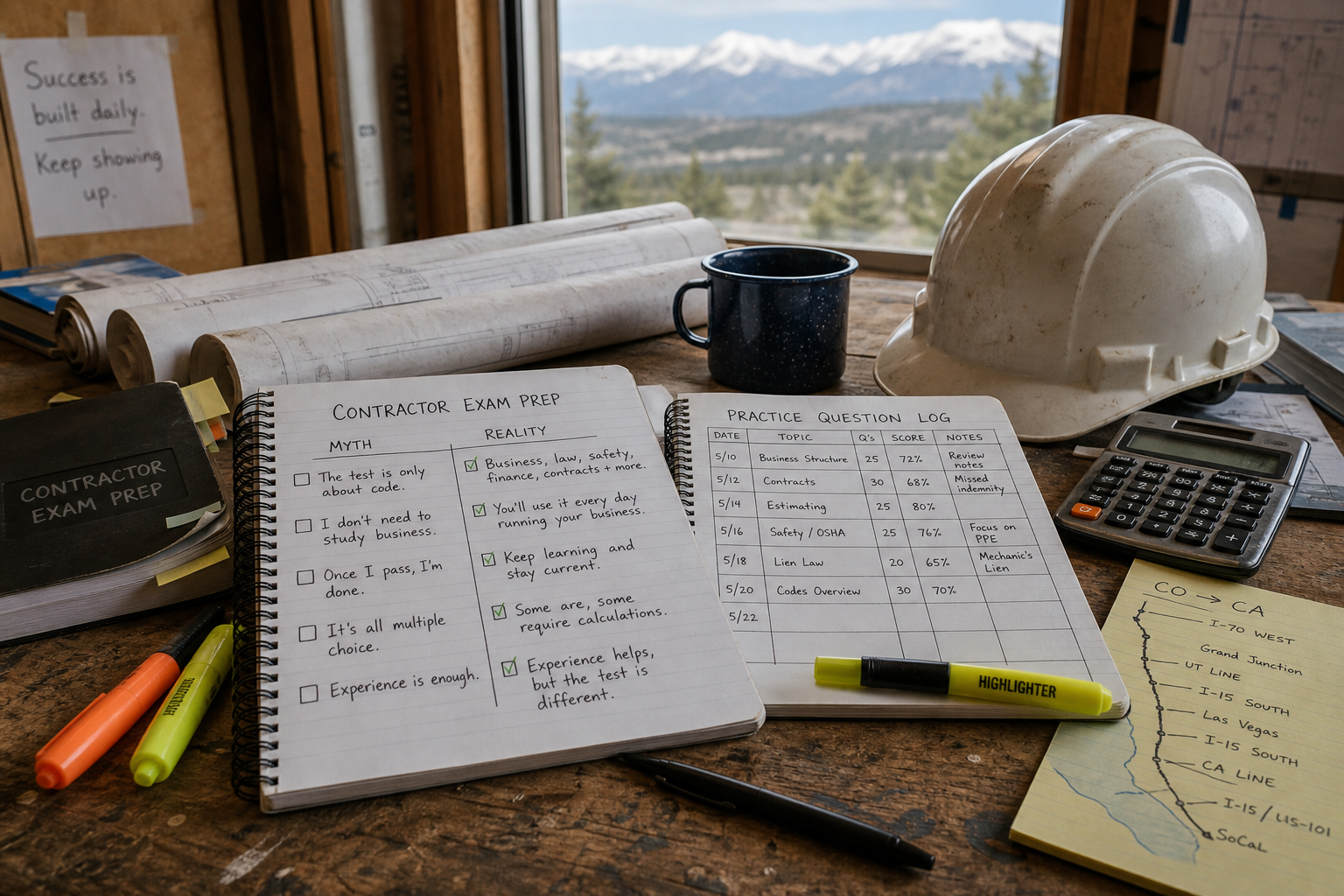
Use this contractor license exam preparation checklist as a myth filter first. If the plan depends on field experience alone, an unsourced prep packet, or one high practice score, it is not ready. A stronger file starts with the official exam notice or application status, the exact classification, agency study guides, separate law/business and trade topics, practice review, and test logistics.
Key points:
- Field experience gives context, but official exam guides define what to verify.
- Prep courses and practice sets should supplement, not replace, agency source material.
- Law/business review and trade-topic review are different study jobs.
- Readiness means explaining wrong answers and logistics, not chasing one unsupported score.
Quick myth filter before you study
Before opening another practice set, run the plan through this contrast table. It turns common assumptions into readiness evidence and gives the page a myth-vs-reality shape instead of a generic prep schedule.
Swipe horizontally to view all columns.
| Assumption | Reality | Readiness evidence | Common risk |
|---|---|---|---|
| Trade confidence alone | Experience needs to be mapped to the official guide | Topic notes tied to the exact classification | Studying familiar work while missing tested terms |
| Generic prep packet | Official source materials control the file | Each supplement is tied to a guide topic | Relying on unsourced or outdated shortcuts |
| One blended study track | They need separate review habits | Separate weak-topic logs for each track | Letting trade confidence hide business-law gaps |
| Single practice result | Wrong-answer review is the stronger signal | Repeated mistakes are explained and retested | Memorizing answers without fixing reasoning |
| Last-minute logistics | Location and deadline rules affect the plan | Appointment, reschedule and retake notes are saved | Choosing a test date before checking constraints |
Myth pattern
The weak pattern is always some version of shortcut thinking: "I have worked in the trade," "this packet looks comprehensive," or "my score was high once." Those may be useful signals, but none of them proves that the study file matches the current official guide.
Reality check
The better test is whether every prep choice can be traced to a source, a topic area, a wrong-answer pattern, or a logistics rule. If it cannot, keep it out of the core plan or label it as optional support.
Turn the corrected assumptions into a checklist
The practical file should be boring and complete. It should name the license classification, the official study guide, the law/business material, the trade-topic outline, the practice log, the weak-topic list, and the appointment or retake rules that affect scheduling.
- Match the exam notice or application status to the exact license classification or trade path.
- Save the official law/business guide and the applicable trade or classification guide.
- List source books, reference materials and guide topic weights before using optional prep material.
- Write the study assumption you are correcting: field experience, generic prep, practice score or logistics.
- Track missed practice questions by topic, source reference and reason for the mistake.
- Record test location, reschedule window, application window and retake notes from the official source.
Use this checklist as the table's action step. Each item should answer one question: what did the myth make you skip, and what proof now belongs in the file?
Myth: Field experience is the whole study plan
What the myth gets right
Field experience matters because it gives the applicant real context for plans, crew decisions, materials, sequencing, and jobsite judgment. It can make abstract questions easier to reason through.
Where experience stops helping
Experience has to be matched to the tested scope. In California, CSLB explains that the contractor examination process includes the standard Law and Business examination and, for most classifications, a second test covering the specific trade or certification area. That distinction matters because jobsite confidence can hide a weak business-law habit or a classification-specific gap.
Start with the CSLB studying for the examination page and the applicable study guide before deciding what to review. Then turn field knowledge into notes under the official topic areas.
Myth: Any prep material is as good as the official source
Where outside resources can help
Outside resources can help with repetition, explanation, and practice. They may be easier to use during short study blocks than a long reference book.
Where source control matters
Optional prep material should sit beside official source material, not above it. CSLB says its examination study guides provide topic breakdowns, sample questions, resource information, and test strategy. Its examination FAQ also warns that no schools or application-preparation organizations are affiliated with or agents of CSLB.
Do not let a generic packet decide the core plan. If a course, book, or practice set cannot be tied back to the current official guide, keep it as a supplement and mark what it is supposed to help with.
Myth: Law-and-business and trade topics use the same prep method
The shared study habit
Both tracks reward careful reading and repeated practice. Both can expose weak assumptions when the applicant reviews missed questions instead of only counting correct answers.
Where the tracks split
Law/business review often depends on definitions, obligations, business processes, and reference material. Trade review often needs classification-specific judgment, plan-reading habits, sequence awareness, and the ability to connect a question to real work without assuming the jobsite version is always the tested version.
Keep two weak-topic logs. One should catch business-law and source-reference gaps. The other should catch trade, drawing, classification, or field-practice gaps.
Myth: A practice score is the only readiness signal
The useful signal
Practice questions can reveal pacing, careless reading, and unfamiliar topics. They are useful when they create evidence.
Where the score misleads
A single practice result can be noisy, outdated, or too narrow. A better readiness record tracks missed topics, misunderstood references, careless reading, time pressure, and repeated trade assumptions.
Review wrong answers in writing. For each miss, record the official topic area, why the tempting answer looked right, and what source would have prevented the error. Avoid pass-rate claims, guaranteed thresholds, or promises. The point is not to invent a magic number; it is to decide whether the file shows stable command of the topics the official guide actually names.
Myth: Test logistics can wait until after studying
Why study still comes first
Studying the material is still the center of the work. Logistics should not become an excuse to avoid the hard topic review.
Where logistics change the plan
Logistics can change the practical prep decision. CSLB says qualifying examinations are taken in person at PSI locations. Its FAQ states that the California Law and Business exam can be taken out of state, while trade exams are available only in California or Oregon. The same FAQ says accepted applications have 18 months to pass the examination or examinations, and that PSI appointments can be canceled or rescheduled without forfeiting the fee if the cancellation notice is received two days before the scheduled appointment.
Those are California examples, not universal rules. They show why every applicant should write down the current appointment source, reschedule rule, application window, travel requirement, and retake plan before choosing a test date.
Reality check: cross-state prep needs separate authority files
A Colorado-based contractor preparing for California should keep two files. One file covers permission to work in Colorado or a Colorado locality. The other covers California exam requirements and study materials. The Colorado Secretary of State's business FAQs say businesses may need to research federal, state, county, and local licensing requirements, with some licenses issued by DORA and others through city or county offices.
That separation keeps the article from mixing licensing authorities. Use the Colorado file for local permission-to-work questions, and use the California file for CSLB exam guides, application status, exam logistics, and classification study. If you are comparing outside resources for the California side, a course library like Test2Pro may fit naturally as one optional prep reference, but the official CSLB materials still need to anchor the study file.
For broader route decisions, see the internal guides below instead of turning this checklist into a regulatory page.
Final readiness test
Ask one final question: can you explain which myth each part of the prep file corrected? If yes, the file should point to the official guide, separate law/business from trade topics, show a diagnostic practice log, record test logistics, and keep cross-state authority questions in the right file. If no, fix the assumption before scheduling around it.