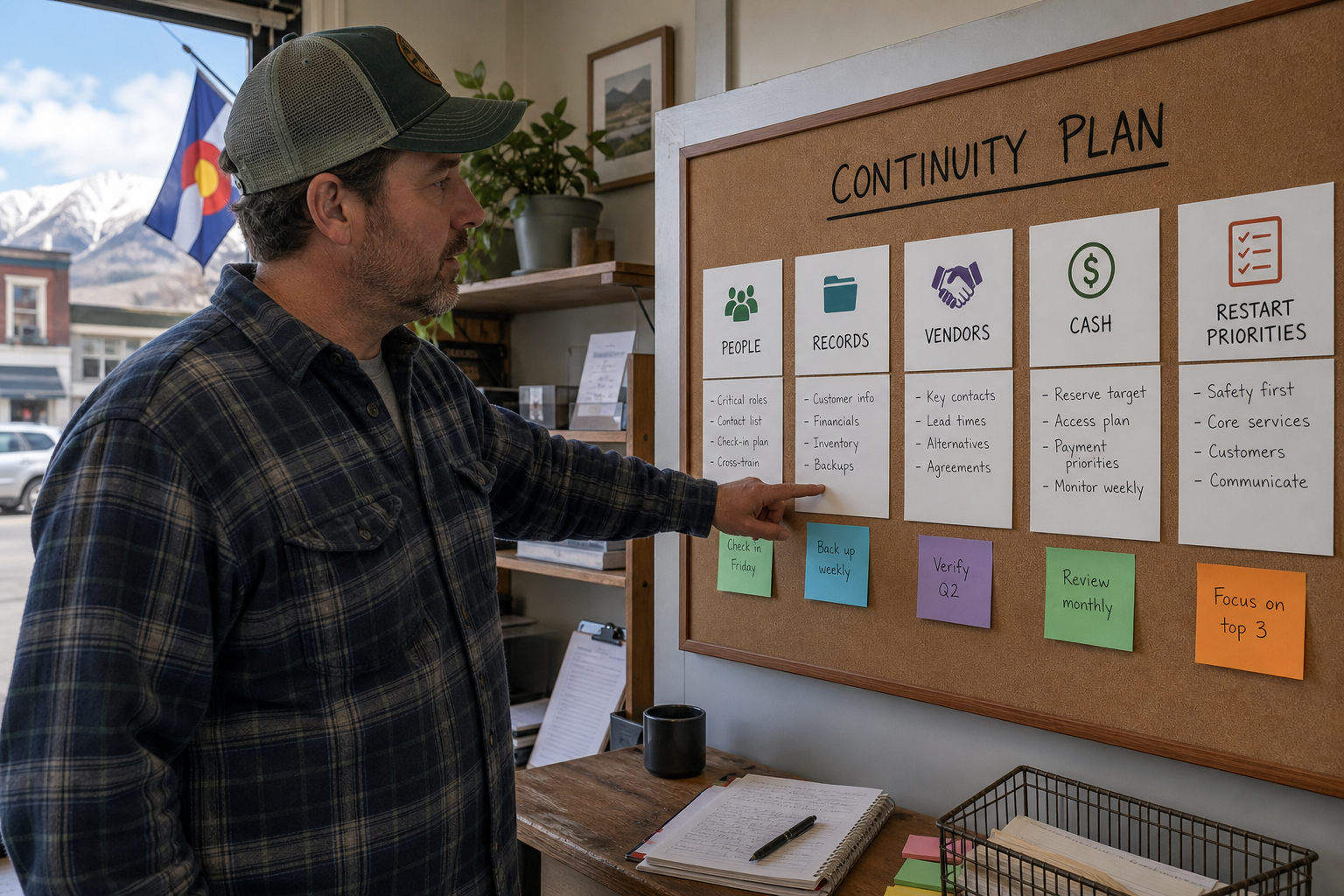
A useful business continuity plan colorado small business owners can actually use starts with one question: what must keep working, or restart first, for the business to protect people and serve customers? From there, the plan should assign people, preserve records, map vendors, check cash timing and set restart priorities.
Picture the first page as a one-page operating card, not a binder. At the top, write the must-run function; beside it, write the owner, backup, record location, outside dependency and first restart decision. If that card can be understood in a tense morning meeting, the plan is pointed in the right direction.
This article is a planning worksheet, not a grant guide, tax opinion, insurance recommendation or contractor licensing page. For broader recovery context, use the Colorado small business recovery guide as the hub and keep this page focused on continuity decisions.
Start with the functions that must restart first
The first section of the plan should name the functions that keep the business alive during a short disruption. For many small businesses, that means employee safety, customer communication, incoming money, order or service delivery, records access and the vendors or systems needed to operate.
SBA emergency guidance tells businesses to assess realistic risks, create a plan and practice it with staff. SBA also says continuity planning should identify critical functions, organize a continuity team and evaluate recovery strategies. That makes the first page of the plan a priority list, not a paperwork exercise.
Write the list in plain operating language. A restaurant might name food storage, reservation updates, payroll, supplier contact and point-of-sale access. A small office might name client notices, cloud files, billing, calendar access and building access. The goal is not to predict every event. The goal is to know what needs attention first when normal operations stop.
Assign people, alternates and communication paths
A continuity plan fails quickly if every task points back to one owner. Each critical function needs a primary person, a backup person and a way to reach employees, customers, vendors, landlords, banks or public emergency resources when the usual channel is unavailable.
Ready.gov business planning guidance includes communications planning, IT recovery and continuity planning as part of preparedness. Ready.gov emergency response guidance also points businesses toward both internal resources and external resources. For a small company, that can be as simple as a contact sheet with names, backup phone numbers, account access rules and the decision each person is allowed to make.
Keep this section short enough to use under pressure. Who sends the first customer update? Who checks staff availability? Who contacts the landlord or building manager? Who can approve a temporary supplier, remote-work day, delayed opening or reduced service menu? If those answers are not assigned before a disruption, the owner becomes the bottleneck.
Protect records before they become recovery blockers
Records are continuity assets. The plan should name which operating documents, financial files, tax records, insurance information, vendor contacts, account credentials and customer communication records must be reachable away from the primary workplace.
The IRS tells taxpayers and businesses to back up electronic files, store them safely and keep duplicates in a separate location. Ready.gov IT recovery guidance connects data backup with the business continuity plan. Use those sources as the reason to make records practical: what must be copied, who can access it, where the copy lives and how often it is reviewed.
Backups are useful only if the right person can access them during a disruption. Verify tax, employment, insurance and record-retention obligations with the responsible official source or professional before relying on a general checklist.
Do not turn the records section into legal retention advice. The article should say to verify record-specific obligations with the right professional or official source. The continuity job is narrower: make sure the owner can find the records needed for payroll, tax communication, insurance contact, customer updates, orders, leases, licenses, passwords and vendor decisions when the main computer, office or file cabinet is unavailable.
A useful records line has four parts: record type, location, backup location and owner. If the business relies on one bookkeeper, one laptop or one password manager account, record that dependency and decide who the backup is.
Map vendor dependencies before a supplier fails
The vendor section should show which outside parties each critical function depends on. That includes suppliers, delivery services, software platforms, payment processors, landlords, maintenance contractors, banks, insurers, internet providers and professional advisers.
SBA recovery guidance points businesses toward supply-chain planning and alternative sources. CISA has also released guidance to help small and medium-sized businesses build supply-chain resilience plans. For this article, keep the lesson practical: identify the dependencies that would stop revenue, staff communication, customer service or safe reopening if they failed.
Start with the functions from the first section. Then ask what vendor, system or contact each function depends on. If customer payments require one platform, who can check service status and where is the support contact stored? If inventory depends on one supplier, what can be substituted temporarily? If the landlord controls building access, who has the after-hours number?
This should not become a procurement or contract-negotiation guide. It is a continuity map. The writer should help the reader see which outside dependencies deserve a backup contact, alternate source, manual workaround or faster decision trigger.
Add a cash-timing checkpoint
Cash timing belongs in the continuity plan because disruptions compress decisions. The page should prompt the owner to list when money normally comes in, when payroll, rent, utilities, loan payments, taxes, inventory and insurance-related costs go out, and which decisions need a bookkeeper, lender or adviser before a disruption lasts longer than expected.
Make the cash review a handoff, not a guess
Use a three-line ledger inside the plan: expected money in, fixed money out, and calls required before terms change. Put a person beside each line so the owner is not trying to reconstruct invoices, payroll dates or vendor promises during the disruption.
Colorado OEDIT says the Colorado SBDC Business Recovery and Resiliency Guide helps small businesses before, during and after a crisis. OEDIT also describes the guide as helping owners identify critical functions, safeguard assets and protect cash flow before disruption. That supports a cash-timing checkpoint without making the article a financial-advice page.
Keep the checkpoint focused on timing and visibility. What receivables may slow down? Which bills cannot wait? What expenses can be paused only after a conversation? Who has access to the balance sheet, bookkeeping system and bank contact? SBA business-management guidance emphasizes bookkeeping and cash-flow projection as part of understanding business finances, so the continuity plan should point readers back to their own records instead of offering one-size-fits-all numbers.
The article should not recommend a loan, predict eligibility or tell the reader which bill to pay first. It should tell them to make the timing visible before an emergency forces rushed choices.
Use a 0-to-30-day restart ladder
The final section should convert the plan into a restart ladder. Ready.gov describes business impact analysis as a way to predict disruption consequences and gather information for recovery strategies. For a small business, that means deciding what happens in the first day, first week and first month instead of trying to solve every problem at once.
Use the timing as a planning sequence, not a guarantee. The right pace depends on the disruption, official instructions and the business's own records.
Use the ladder as a planning tool. The first 24 hours are for people, safety, basic communication and access to records. Days two through seven are for vendor checks, cash timing, temporary operations and customer expectations. Days eight through thirty are for reopening priorities, recovery strategy, staff practice and updates to the plan.
The output of this article should be a simple worksheet: critical functions, people and backups, records, vendors, cash timing and restart steps. If a reader can fill those in and know what to verify next, the page has done its job.
Keep the close short. A continuity plan does not need to be perfect to be useful. It needs to be current enough, assigned enough and accessible enough that the next disruption starts with a plan instead of a scramble.