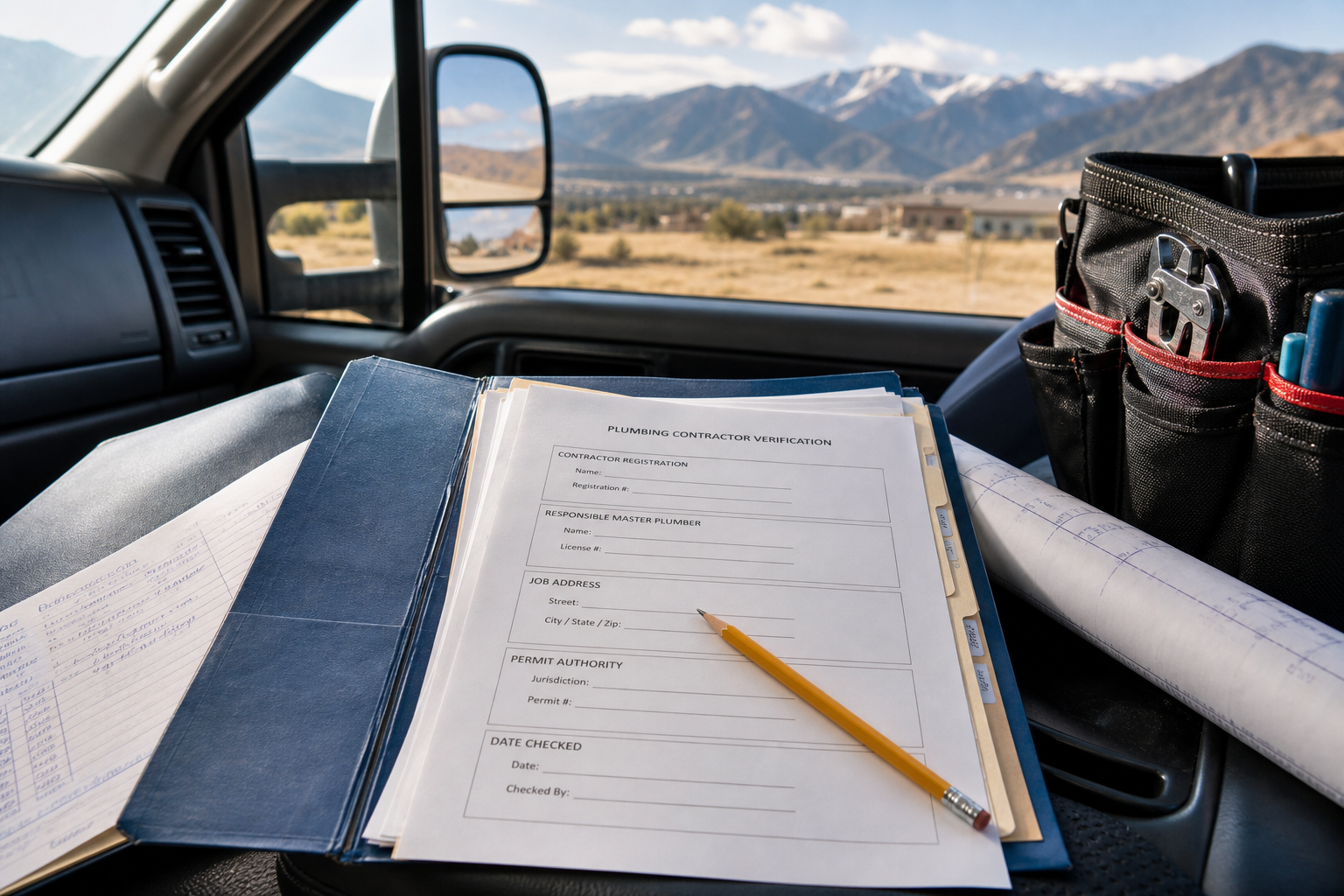
If you are checking colorado plumbing contractor registration, do not start with a generic contractor-license assumption. Start with the situation in front of you: a new plumbing business, a qualifying-master relationship, a public number mismatch, a local permit gate, or a stale record that needs rechecking.
Key points:
- State plumbing contractor registration belongs to the DORA layer, not a city-only contractor-license shortcut.
- The qualifying master record has to match the business situation, not just appear somewhere in old paperwork.
- Public identifiers on bids, invoices, vehicles and websites should be compared with official records.
- A job address can still create local permit, inspection or filing requirements after the state record checks out.
- Save the official source URL and date checked so the next bid, office review or permit call starts from evidence.
Scenario 1: A new plumbing business wants to bid under its own name
When this case fits
A new plumbing business should verify the state plumbing contractor registration path before it bids, advertises, or accepts plumbing work under its own company name. The DORA Plumbing Applications page is the source to check for the current application route and the Plumbing Contractor Acknowledgment of Responsibility reference.
This scenario is not the same as asking whether Colorado has one statewide general contractor license. Plumbing is a regulated trade area, and this registration question belongs with DORA and the state plumbing board first. A local contractor-license page may still matter later, but it should not replace the state trade-record check.
What to save first
The first planning file should include the legal business name, the state application or lookup source, the date checked, and the unresolved question that still needs confirmation. If the business is not ready to verify a state record, do not treat a local filing or general business registration as enough for plumbing work.
For a new owner, the cleanest question is narrow: do we have a state plumbing contractor record to point to before the local permit conversation begins? Keep the answer modest. A verification file proves what has been checked; it does not promise that every future application, inspection, or local review will be accepted.
Scenario 2: The contractor relies on a qualifying master
What to match
If the business relies on a qualifying master, the registration review has to connect the contractor record to that person. Colorado State Plumbing Board rules say a plumbing contractor that loses the services of the responsible master plumber has twenty days to hire another master plumber; otherwise the registration is placed into a Need Master Hire-Cannot Practice status until the issue is resolved and the appropriate fee is paid.
That makes this a live relationship check, not a one-time credential note. The file should answer three practical questions: Who is the named master? Does the official record still support that relationship? Has any change happened that would require a new verification step?
Five scenario routes for the registration file
Verify state registration before bidding
Confirm the current DORA plumbing contractor application or lookup source before advertising or taking plumbing work under the business name.
Match the master to the contractor
Compare the contractor record with the qualifying master record and flag any relationship change before relying on the file.
Reconcile visible identifiers
Check registration and master plumber numbers against websites, bids, invoices, billing materials and vehicles.
Check the job-address authority
Determine whether the Board or a local authority having jurisdiction handles the permit, inspection or local filing requirement.
Refresh stale proof
When a record, address or qualifying-party relationship changes, update the public materials and save a fresh source check.
Use the route that matches the current problem, then save the evidence note.
If the relationship changed
Use the flow as a working route. If the contractor name, master plumber name, license number or status does not line up, pause before relying on the record. For the broader non-plumbing layer, use the Colorado contractor license requirements hub. For electrical-specific DORA records, use the separate Colorado electrical contractor license and DORA page instead of blending the two trades here.
This scenario is also where office habits matter. Do not keep the responsible-party note only in a bid folder, only in a website footer, or only in one person's email. Put the official lookup source, checked date, and role note in the same place so the estimator, owner, permit coordinator, or subcontractor reviewer can see the same evidence.
Scenario 3: The public registration numbers do not match
What to compare
A number mismatch is its own scenario because it is easy to overlook. On and after July 1, 2025, Colorado plumbing rules require contractors to display the contractor registration number and the master plumber license number on company vehicles, billing materials, bid sheets and websites.
If a website, bid sheet, invoice or truck shows a number that differs from the official lookup result, treat that as a reconciliation task. Compare the legal business name, registration number, master credential identifier, record status and date checked. Do not explain the conflict away with memory or old paperwork.
What not to assume
The Colorado DORA license verification page allows searches using fields such as profession, license type, license number and status. Use only as much search information as needed to find the record, then save the result date rather than assuming a screenshot from a previous job is current.
A mismatch does not automatically explain why the numbers differ. It only tells the business or reviewer what to check next. The record may be stale, the public material may be old, or the wrong number may have been copied into a template. The next step is to reconcile the official record and the public material before the number appears on another bid, invoice, vehicle or website page.
Scenario 4: The job address creates a local permit gate
The address decides the next authority
State registration is not the final gate when a real job is ready for permit review. State plumbing rules require permits and inspections for plumbing, fuel gas piping, water conditioning equipment installation or manufactured-home hookup work either through the Board or the local authority having jurisdiction, and permits must be issued before work starts.
- Legal contractor or business name
- State contractor-registration number or official lookup result
- Qualifying master name and license number
- DORA or board saved source record
- Job address and authority having jurisdiction
- Local permit, inspection or contractor-card filing notes
- Public-facing number check for website, bid sheet, invoice and vehicle materials
Build the local packet
That means the job address still matters. A Denver project may ask plumbing contractors for a current State of Colorado Plumbing Contractor card and a copy of the Master Plumber's driver's license or ID with the local application. Aurora publishes a different local handling note: electricians and plumbers must have current State of Colorado master's and contractor's licenses on file with the Building Division, and Aurora says it does not issue a separate plumbing or electrical contractor license.
Use those local examples only as examples. They show why the file needs the job address, permit authority, state lookup result and local filing notes. They do not create a Denver rule for every city, and they do not turn this page into a Boulder or city-specific contractor checklist.
A good permit-gate file is short enough to use before a call or application. It should show the job address, the authority likely to handle the permit or inspection, the state record checked, the local document requested, and the source date. If the project moves to another jurisdiction, copy the format, not the answer.
Scenario 5: A registration or responsible-party record changes
Refresh before the next public use
A stale record can be just as risky as a missing record. If the company changes its address, public identifiers, qualifying-master relationship or website display, the registration file should be updated and rechecked before the next bid, invoice, permit or inspection conversation.
Colorado rules require plumbing contractors to update required displays if the company's plumbing contractor number or named master credential changes. The practical takeaway is simple: compare the official record to the public materials, then save the official page reference with a checked-date note.
Watch scope traps too
The DORA/State Plumbing Board water heater memorandum is a useful reminder that scope can also trigger the registration and permit question. It states that domestic water heater installation and replacement must be done by a licensed plumber working for a registered plumbing contractor that has secured a permit, and that a permit and inspection by the authority having jurisdiction are required. Use that as a scope trap example, not as a replacement for checking every project category.
A renewal or record issue often surfaces at the worst time: a bid deadline, an inspection question, or a customer reviewing a website before signing. Treat that moment as a file-cleanup signal. Recheck the official record, fix public-facing materials when required, and note what changed so the next reviewer does not repeat the same search.
FAQ: plumbing registration planning questions
Frequently asked questions
Does Colorado require plumbing contractor registration?
For plumbing contractor work, start with the state board and DORA layer. An official memorandum quotes the rule that a person or business may not operate as a plumbing contractor until the contractor has obtained board registration.
Can one master plumber be used as the responsible-party proof?
Use the official record rather than an assumption. If that relationship ends, the supported board rule gives the contractor twenty days to hire another master plumber before the registration is placed into a cannot-practice status.
Do local permits still matter after state registration?
Yes. Colorado plumbing-board rules require permits and inspections for covered plumbing and related work through the Board or the local authority having jurisdiction, depending on the job location.
What numbers should public materials display?
Colorado rules require plumbing contractors to display the plumbing contractor registration number and the named master's credential number on company vehicles, billing materials, bid sheets and websites.
Where should the current record be checked?
Use official DORA/DPO and board sources, including the Colorado DORA license verification page and the current plumbing rules, then save the saved source record.
The common thread is evidence. Pick the scenario, verify the official state record, check the local permit authority when there is a real job address, and keep the proof current enough that the next person reviewing the file can see exactly what was checked.
This page should leave the reader with a practical worksheet result: a named scenario, an official source, a checked date, and the next authority to contact. If any of those pieces is missing, the registration file is not ready to rely on.